Tuesday, 11 March 2014

But square-cut or pear-shaped, These rocks don't lose their shape. Diamonds are a girl's best friend.

Click here to see Marilyn Monroe sing "Diamonds are a Girls Best Friend"
In an affidavit made on the 24th of July 1886, to Pretoria's Mine Department, South Africa, prospector George Harrison stated " I come from the newly discovered goldfields of Kliprivier, especially from a farm owned by a certain Gert Oosthuizen. I have a long experience as an Australian gold-digger, and I think it is a payable goldfield". This turned out to be a huge understatement and this area became the site of a huge gold rush and lead to the formation of the town of Johannesburg. It was initially laid out on the five farms in the area, the population in 1866 was 600, by 1892 it was 40,000, 1905 -  150,000 and now 3.2 million.
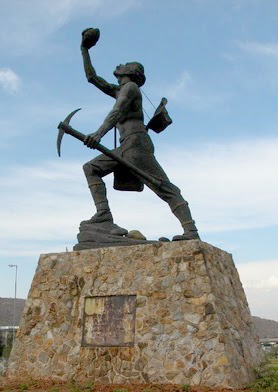
The statue of George Harrison Australian gold prospector
can be seen in Johannesburg, South Africa.
Claims were furiously staked, bought and sold till large companies emerged. The mines attracted thousands of immigrant "uitlanders" workers.  I read this story about one group of these miners that is said to have lead to the formation of the "Kimberley Diamond Mine. Fleetwood Rawstone and his group of fellow diggers, known as the "Red Cap Party" had staked their claim on the Northern Cape Farm of Vooruitzicht.
Fleetwood Rawstone and the Red Cap Party working their claim.

One day they were were annoyed when their servant and cook Esau Damoense know as Damon had too much to drink and as a punishment sent him to a nearby hillside and told him not to return till he found a diamond. (Perhaps inspired by the story of 15-year-old Erasmus Jacobs who in 1866 found the first diamond in South Africa on the banks of the Orange River, near Hopetown, a 21.25 carat diamond in the rough - later to be called "The Eureka") A sober Damon returned a few days later  with a few shiny stones, one of these being a 83.50 carat (16.7 g) diamond he found. The group rushed to stake their claim on the hillock ( they named Colesberg Kopje) and very quickly this area became a busy mining community. The site was named DeBeers New Rush after the brothers who owned the Vooruitzicht Farm. In 1873 the community was named Kimberley in honour of the British Colonial Secretary, Lord Kimberley.
The hillock soon disappeared, no wonder -  1,600 separate claimants all digging deep into the "blue ground" or kimberlite that surrounded the diamond bearing volcanic pipe. Conditions for the miners were dangerous and primitive. They lived in tents, corrugated iron huts, tarpaulins and no sanitary services, lack of fresh vegetables, landslides all taking their toll on the miners.

Old Diamond Mining Scene
As the digging continued, Cecil Rhodes got a foothold in the Kimberley mine enlarging his holdings till finally in 1888 he  payed over 5 million pounds to take over the area and the De Beers Consolidated Mines Ltd was formed taking its name from the brothers who owned the farm.

Rhodes along with Alfred Beit, Frederick Philipson-Stow and Barney Barnato were given the position of life time governors. Sadly for Barney Barnato he drowned in mysterious circumstances in 1897 aged 44 and Cecil Rhodes died aged 48 of heart failure, Alfred Beit died aged 53 of a stroke, Frederick Philipson-Stow died aged 59.
In 1913 Earnest Oppenheimer became the mayor of Kimberley and in 1927 he managed to wrest control of the De Beers empire, building and consolidating the company's global monopoly over the world's diamond industry until his retirement. During this time, he was involved in a number of controversies, including price fixing, he died in Johannesburg in 1957.
The Kimberley Mine or Big Hole was closed in August 2014 at the outbreak of the First World War after 43 years of life and 14,504,375 carats of diamonds were mined.The most famous diamond found here is the The Tiffany Yellow Diamond - one of the largest yellow diamonds ever discovered; it weighed 287.42 carats (57.484 g) in the rough, 128.53 carats (25.706g) after cutting.The stone was purchased by New York jeweller Charles Tiffany. The cutting was carried out in Paris by a 23 year old George Kunz who studied the stone for a year before cutting it. He added  additional facets to the accepted square antique brilliant cut - bringing the total to 82. The diamond is known to have been worn by only two women - Mrs Sheldon Whitehouse at the 1957 Tiffany Ball held in Newport, Rhode Island, mounted for the occasion in a necklace of white diamonds. Then by Audrey Hepburn in 1961 publicity photographs for Breakfast at Tiffany's.
The necklace of diamond ribbons surrounding the Tiffany Diamond was worn
by actress Audrey Hepburn in 1961.
When not being exhibited around the world it returns to its permanent place of honour on the main floor of the Tiffany Fifth Avenue store, New York.


Today all that remains of the Kimberley Mine is a huge crater 214 metres deep with a surface area of 17 hectares and a perimeter of 1, 6 km.
Visit the Kimberely museum set up by De Beers in Johannesburg.

Tuesday, 14 January 2014

A more attractive product of volcanic action.....

Just back from a week enjoying the sunshine of Lanzarote, one of the Canary Islands, part of the modern Spanish provence of Las Palmas. 
Lanzarote was called Titeroigatra meaning The Red Mountains by the indigenous people of the Canary Isles, the Guanches, but renamed after the Geonese Navigator Lancelotto Malocello to Insula de Lanzerote Marcelus in the 14th century.
The island of Lanzerote created from Larva
 
The Canary Isles were created by the solidifying of the larva from fiery eruptions following the break up of the African and American continental plates 15 million years ago.
Timanfaya National Park is the volcanic area on Lanzarote and the most recent volcanic landscapes; created here when in September 1730 a fissure eruption started. This lasted for 6 years and buried 11 villages and 200 sq km of agricultural land land was covered and the lava poured into the sea along 20km of coastline.
The volcanos here lie away from an active plate boundary so it is thought that an intermittent supply of lava comes from a hot spot or mantle plume.
So now what about this caught my attention? Well one of the products of all this volcanic activity is the formation of Olivine the mineral variety of the gemstone Peridot.
Olivine is formed in a magma which is rich in iron and magnesium called mafic magma. When the magma cools and as the olivine minerals have a high crystallisation temperature, they are one of the first to form. Some ultramafic rocks can be composed of almost all olivine and these are called dunites or peridotites.
Dunite is a rock type that is almost wholly composed of olivine. 
Olivine is actually a name for a series of minerals which are categorised between the two end members fayalite or forsterite. Fayalite is the iron rich member, forsterite (named after the German naturalist, John Forester) is the magnesium rich member. The two minerals form a series where the iron and magnesium levels vary. Fayalite due to its iron content has a higher index of refraction, is heavier and has a darker colour than forsterite.
Olivine is one of the most common minerals in the earth and is a major rock forming mineral. Despite this, good specimens and large crystals are rare and sought after, small and microscopic grains are found worldwide. Olivine is also found in meteorites. Olivines are susceptible to weathering and can be altered by a series of chemical reactions to form the mineral serpentine.
Olivine has several industrial uses. It is used as a flux for steel production and is also an important ore of the metal magnesium. Read here for more uses.
Olivine's gemstone variety, known as peridot, it is the birthstone of August and is a green-yellow colour. Its chemical formula is given by: (Mg,Fe)2SiO4. Mohs Hardness 6.5 to 7.
It is quite a brittle stone so not one to wear whilst gardening, save it for the special occasions. 
Peridot and diamond ring handmade by Maker Mends Ltd.

Most peridot is actually the magnesium rich forsterite and its colour is caused by the presence of iron ions. Fayalite's higher iron content make for darker, less attractive specimens that are not generally used as gemstones. Peridot is one of the few gemstones that occur in only one colour, “idiochromatic” as their colour is created by the basic chemical composition of the mineral, it can only be found in shades of green. The most valued colour is a dark olive-green.The best coloured peridot has an iron percentage less than 15% and includes nickel and chromium as trace elements that may also contribute to the best peridot colour.
It is a relatively inexpensive gemstone in small sizes, but the value goes up with stones over 5 carats, with 10-15 carat stones very rare and expensive.
The largest cut Peridot weighing 310 carats is on display in the Smithsonian 
National Museum of Natural History, Washington D.C. This was found on as St. John Island in the Red Sea. Peridot was mined for over 3,500 years on the volcanic island of St. Johns Island (also known as Zagbargad; Zabargad; Zebirget; Seberged; Topazios) and the deposits rediscovered in 1900. It is also found in Myanmar (Burma), Arizona, New Mexico, and Hawaii, in the US, China, Pakistan, Norway, Brazil, Australia, Kenya, Mexico, Sri Lanka, South Africa and Tanzania. The United States was one of the largest producers of peridot with an estimated value of production of $1.5 million in 1999.
In Naturalis Historia, Pliny the Elder tells of the first specimen of Peridot being presented to queen Berenice; Theban queen of Lower Egypt, about 300 BC.
In 2006, olivine was found in comet dust brought back from the
 Stardust space probe.
Many of the gift shops sell souvenirs made from the black basalt with olivine crystals.
Clock with a few strategically positioned Olivine crystals glued on. 
Olivine is abundant on Lanzerote and often forms easily noticeable green phenocrysts  (relatively large and usually conspicuous crystal) in black basalt. 
But of course I wanted to find my own samples of olivine, it wasn't that  easy! I found a few but not the hoard I was hoping for. (pride prevented me from purchasing samples from the local mineral shops). 
Black basalt containing olivine phenocrysts as found by me.
If you can't make it to Lanzarote anytime soon the Natural History Museum London has samples of Olivine and Peridot in its mineral and gemstone display.
Uncut Peridot sample on display at the Natural History Museum


Monday, 4 November 2013

"A cloud, from which mountain was uncertain, at this distance (but it was found afterwards to come from Mount Vesuvius), was ascending,

the appearance of which I cannot give you a more exact description of than by likening it to that of a pine tree, for it shot up to a great height in the form of a very tall trunk, which spread itself out at the top into a sort of branches; occasioned, I imagine, either by a sudden gust of air that impelled it, the force of which decreased as it advanced upwards, or the cloud itself being pressed back again by its own weight, expanded in the manner I have mentioned; it appeared sometimes bright and sometimes dark and spotted, according as it was either more or less impregnated with earth and cinders."
Pliny the Younger recounting the eruption of Vesuvius in 79AD.
Mount Vesuvius, Ottaviano, Naples, Italy present day.


Having recently been to the British Museum to attend the Pompeii and Herculaneum Exhibition  and seen the jewellery, coins and gems and objet d'art  that survived the eruption of Vesuvius - I will write about those before returning to the subject of laboratory grown gems.
Gold and quartz earrings found at Pompeii

The Roman Empire was vast and full of resources such as gold, silver, electrum - a naturally occurring alloy of silver and gold, precious gemstones such as emeralds, pearls, diamonds and sapphires. Romans liked to show off their wealth and status by embellishing  their homes with beautifully made objects and adorn themselves with jewellery.  Although for a time only higher-ranking men were allowed to wear gold signet/seal rings, the lower classes wore cheaper brass or iron rings. Wealthy roman women wore the types of jewellery still worn today, rings, earrings, bangles, chains etc. Brooches were used to fasten clothes, boys wore amulets called "bulla" to ward off evil. The less well off were happy to wear jewellery made from glass or even bone. Early Roman jewellery was inspired by the Greek and Etruscan (Etruscan is the modern name given to a civilization of ancient Italy) art, later Egyptian influenced styles became popular.
Click here to see a wonderful selection of Roman artefacts including jewellery and coins, discovered at Pompeii and Herculaneum.
The owner of this beautiful silver drinking vessel would have
proudly displayed it for all visitors to see.  

Roman Coins - you can read in detail here about Roman coins - coins were produced throughout the Roman Empire see a list here of the Roman Mints.
Coins were created by striking with a hammer a blank metal disk, called a flan, which was placed on an engraved bronze punch. All coins were struck by hand, thats why many Roman coins were often struck off-centre so that part of the design was lost off the edge of the coin and the coin did not have a uniform thickness. Collectors of Roman coins place a higher value on a well struck coin. Read how coins were made in more detail here.
In 23 BC, Augustus overhauled the coinage system creating the following correlations:
1 Aureus(gold coin)= 25 Denarii (silver)
1 Denarius = 4 Sestertii (large brass coin)= 8 Dupondii (brass coin) = 16 Asses(bronze) = 64 Quadrans  (bronze coin).
The denarius was the backbone of the Roman economy for 5 centuries, the silver content and accompanying value slowly decreased over time.

Titus Flavius Vespasianus  was Emperor when Vesuvius erupted. He was born in AD 41 and grew up at the court. Records state he was a popular, handsome and talented youth, intelligent and skilled at warfare. Titus’ reign not only saw the eruption of Vesuvius in AD79 but in AD80 the another fire in Rome and an outbreak of plague. He spent his personal wealth to aid those affected by the disasters. He died young as was mourned as an emperor with the best interests of his people at heart. Coins of him were issued from 79 until 81.  A denarius found in Pompeii proclaimed the latest collected titles of the victorious Emperor Titus, acclaimed emperor for the fifteenth time, Titus did not receive his 15th Imperial acclamatio until September AD79, so helping date the eruption of Vesuvius to after this time.
Coins of Titus Flavius Vespasianus were issued from 79 until 81.
Coins were often incorporated into rings, pendants and on bangles.

Following the eruption of Vesuvius many people fled however, it is believed that some  thought it was safe return to collect their money and belongings. Several bodies were found clinging to valued possessions or objects that might bring them good luck. What they didn't know was the worst was yet to come, the danger wasn't from the ash causing suffocation.
What caused the death of so many so quickly was a process called Pyroclastic Current  - this is a cloud of hot gases and rock that rapidly flows from some volcanos when they erupt, as fast as 300km an hour hugging the ground as they flow down the slopes.  In Herculaneum only 7km away temperatures of the flow reached 500 ÂșC, death was instantaneous, flesh was vaporised from the body - all that remained were the blackened skeletons.
The citizens of Pompeii,  further away weren't so lucky they had a more prolonged death. Forensic investigation of the positions of some bodies showed them to be in the "Pugilistic Attitude - that is arms positioned as if they were boxing this is because extensive heat leads to coagulation of muscle proteins and shortening of muscle fibres resulting in flexion of big joints. It is consistent of extreme/intense heat at the moment of death. Experiments have shown the  temperatures here  were between 200 to 250ÂșC . The flesh was cooked, clothing remained intact. The bodies were coated in volcanic ash which hardened which cooled and preserving the shape of the bodies. In modern times these were used as casts and filled with plaster  to preserve them.
A cast of a Pompeii victim his arms drawn up as if boxing
Pugilistic Attitude - caused by extreme heat at time.
Click Here to see the British Museums TIme Line of the Eruption of Mount Vesuvius in 79AD.
WIth some of these victims were also precious possessions that were grabbed in the panic to escape including jewellery, coins and gems. As intense as the heat was it still wasn't hot enough to melt the metals as Gold melts at 1064ÂșC, Silver at melts at 962ÂșC.
Most of the jewellery and coins were found next  to the body at the hip - where they would have been kept in purses tied to the hip.

A woman was found with bags of jewellery and gold and silver coins - more wealth than found with any other body. The only piece of jewellery she was wearing was the large necklace or "body chain".

This fused mass of bronze coins and a handful of silver denarii, once contained in a  wicker basket, was found on the Herculaneum ancient shoreline.
Snake Jewellery was very popular with the Romans, they were fond of Egyptian styles.
This solid gold bracelet shows amazing detailing.


Pliny the Elder, Gaius Plinius Secundus, in his writings named Naturalis Historia discusses the use, history and properties of gold, jewellery and precious stones used in the Roman Empire at his time . You can read an excerpt here.

One third of Pompeii and two thirds of Herculaneum are still unexcavated and it is possible that many bodies and their jewellery and coins have yet to be uncovered in and around the cities. Find out how to be a volunteer at an archeological dig site.
Thank you to the British Museum for some of the images,  there now is an exhibition about  gold in ancient Columbia - called Beyond El Dorado

Coincidently we were asked to produce a replica of a Roman coin in gold and set it into a pendant. The easiest method for us to use was the loss wax process, whereby we carved the desired image in wax and used this to make a cast into which melted gold was poured. After this cooled it was removed from the mould and hand finished to give the desired effect.
the finished coin
the carved wax


Wednesday, 11 September 2013

The twilight turns from amethyst.....


To deep and deeper blue, 

The lamp fills with a pale green glow 

The trees of the avenue.
The old piano plays an air, 


Sedate and slow and gay; 

She bends upon the yellow keys, 

Her head inclines this way.

Shy thoughts and grave wide eyes and hands 
 
That wander as they list--
The twilight turns to darker blue 
With lights of amethyst

THE TWILIGHT TURNS FROM AMETHYST
by: James Joyce (1882-1941)

Almost all gems can be synthesised -
What is a synthetic - A synthetic is a man-made material, which has the same composition and crystal structure as the natural material. The first gemstone to be created in laboratory was Quartz all the way back in 1845 - by German geologist Karl Emil von SchafhÀutl. He grew microscopic quartz crystals in a pressure cooker using an early version of the Hydrothermal Method (described below).
Quartz ((SiO2) is a crystalline rock or mineral it is composed of the product of silicon and oxygen – silicon dioxide. Quartz is the second most common mineral in the Earth's continental crust (natural ice being the most common, see my previous Blog "An Emerald Is As Green As Grass" to read about minerals) and found in all types of geological environments. There are 49 variety's, a number of which are gemstones, e.g. amethyst,  citrine, smoky quartz, rock crystal, rose quartz. Origin of name from Saxon word Querkluftertz = cross-vein ore. The colour varies from colourless, white, grey, yellow to brown to black, violet, pink and purple.  In spacious cavities quartz crystals can grow large, sometimes weighing several tons. Clear colourless quartz, called rock crystal, is the most common gem mineral.  Rock crystal is used for carvings, chandeliers and crystal balls.
Take a look here at a beautifully carved rock crystal ewer from Egypt  AD 969-1171
In the Smithsonian Institute is the world's largest, flawless quartz sphere. It is 242,323 carats, weighs 106.75 lbs. (48.5 kg), and measures 12.9 inches (32.7 cm) in diameter. The sphere was cut and polished in China in 1923-1924, though crystal from which it was cut may have come from Burma.

Example of a Rock Crystal Chandelier
However, the need to synthesise quartz came about not for adornment but for its use in technology. 

The discovery of piezoelectricity (from the Greek word meaning “to press”) by the Curie brothers was an important scientific discovery. Pierre and Jacque found that when pressure is applied to certain certain nonconducting crystals, such as quartz, it polarizes them resulting in an electric field which is detectable as a voltage. When subjecting piezoelectric crystals to an externally applied voltage, inverse piezoelectricity, the crystals change shape by a minute amount. When the polarity of the voltage is alternated, the crystal rapidly expand and contract producing a vibration. This deformation, although only nanometres, has important practical applications such as the production and detection of sound.

Paul Langevin, a student of Pierre Curie's, found that inverse piezoelectricity causes piezoelectric quartz in alternating fields to emit high-frequency sound waves. This led to the use quartz in a variety of applications including the first practical transducer (A transducer is an electronic device that converts energy from one form to another ) for ultrasonic pulse-echo detection which were used to detect submarines and explore the ocean's floor.

Pierre and Jacque Curie


When a crystal is made to vibrate at its natural frequency by the application of a voltage, the system is said to be in resonance. A crystal in resonance will maintain a constant, unfaltering frequency. When coupled with vacuum tubes or transistors, this constant frequency can be changed into a radio signal so Piezoelectric crystals were also used in radio broadcasting and stereo equipment.

Quartz is also used in timekeeping as an oscillator to keep regular time (an oscillator is an instrument for producing movements of a regular speed - oscillations ) In a quartz timepiece, a small ring-shaped piece of crystal is made to vibrate at its natural frequency – resonance. A microchip reads how many times the quartz vibrates each second -an incredible 32,768 times per second!! and uses that information to keep accurate time. Because the crystal's vibration is consistent, quartz clocks are among the most precise timekeeping devices. Quartz crystals can be used to regulate both digital and analog clocks and watches.

Quartz crystals also time and coordinate signals for microprocessors, computers, programmable controllers and other digital equipment.
Read in detail about piezoelectricity here.


Hydrothermal Quartz

Quartz is grown in an autoclave or "bomb" that is divided into 2 sections, the Dissolving Zone and the Growth Zone.

Crushed quartz or silicon crystals (Lasca) are added to the dissolving zone with water and a mineralising agent such as sodium hydrochloride or sodium carbonate, this mixture known as the Nutrient. The Growth Zone has sections of seed crystals, plates of quartz on which the crystal will grow. The shape of these seeds determines the shape of the resulting crystal. The autoclave is heated to 400ÂșC and this raises the pressure to 21,000 psi causing the crushed quartz to dissolve in the liquid. Due to convection this then rises through the Baffle into the growth zone. The Baffle restricts and shapes the flow of the convection of the nutrient into the Growth Zone.

As the supersaturated solution moves up to cooler growth zone, about 50ÂșC cooler, it can't hold on to the silica and it is deposited on the plates. As the nutrient cools it flows down and the process continues until there is no longer enough Lasca dissolved to saturate the nutrient mixture.

Crystal up to 50mm x 150mm can be grown in 3 to 4 weeks, sometimes it can take a year to grow larger crystals. These are created by using these first generation pieces as the seed plates in a second or even third run. There are facilities that grow huge crystals up to a metre across and 15 metres high.

The growing chamber for quartz crystal
Of course quartz can also be produced for the Jewellery Industry, again its personal preference whether or not you want natural or synthetic. 

Synthetic quartz can be coloured "doped" by adding other minerals; adding Iron will turn the quartz green or yellow to make Citrine, Cobalt will turn it blue (natural blue quartz does not exist)  and to make Amethyst iron oxide is added and the crystals exposed to radiation.
Diagram of an autoclave.

Another type of man-made quartz, fused quartz, is made by melting down pieces of natural quartz and reforming it into almost any shape. Fused quartz doesn't expands or contract with changing temperatures, so is an ideal component of scientific equipment, such as telescope and microscope lenses. It also is an conductor of heat, light, and ultraviolet rays and  it can be used to direct light rays through bends and angles. It is nearly impervious to acids and other chemicals so is often used to make test tubes and other chemical containers.


Next time other synthesised gemstones and the methods used.


Thursday, 1 August 2013

We dig dig dig dig dig dig dig in our mine the whole day through, To dig dig dig dig dig dig dig is what we really like to do, It ain't no trick to get rich quick, If you dig dig dig with a shovel or a pick, In a mine! In a mine! In a mine! In a mine! Where a million diamonds shine!


The Seven Dwarves singing happily as they excavate some amazing diamonds and other gemstones just sticking out of the surface.
 A Disney View of diamond mining!

So why not buy laboratory grown diamonds? They are cheaper, better clarity and unless being examined by an expert, indistinguishable from natural diamonds. I suppose it's down to personal taste, why you want a diamond in the first instance. Personally I like the fact that natural diamonds are billions of years old created by an act of nature,  I find that amazing, even though I know diamonds aren't the rare commodity the industry would have us believe.
Then there is the argument  that by buying lab grown diamonds you are not adding to the damage to the earth and the exploitation of workers caused by the mining natural diamonds. The diamond industry gives employment to many people, how would a reduced diamond mining industry effect the workers? What alternative jobs are available?
Should the mining industry nationalised, so that the countries themselves benefit? I think I would be more comfortable if I knew the workers were benefitting more from the profits. If the diamond mine owners provided the mining communities with housing, schools, medical support, a decent standard of living and a voice that is listened to without being shot at, arrested and tortured.
I found it really hard to find an image of the inside of a diamond mine to show the working conditions, all I found was this old article (2002),
I really hope conditions have improved since then however the miners strikes in 2012 lead me to believe little has changed. I hope someone can prove me wrong. Here is an article explaining about the strikes.

Not that I want to ruin the pleasure that Diamonds give so many, just highlight the human cost. This is a very complex subject economically, politically and morally, one that I can only begin to comprehend. But what is obvious are that changes are clearly necessary and sooner rather than later.

Listen to Ladysmith Black Mambazo -Nansi Imali (Here Is The Money) ,


Here is the money dug by the men in the mines
Where the fainthearted will not go
We congratulate our men for their bravery
And for risking their lives
We salute you
(written by J. Shabalala) 

Sorry to keep going on! just a quick mention on the subject of Blood Diamonds - since 2003 The Kimberley Process has worked to stem the flow of diamonds being sold to raise monies to fund conflicts. All diamonds sold should have a disclaimer to declare that to the sellers knowledge the diamonds were obtained from sources not associated with the funding wars. How successful have they been?  This article was recently published in the online guardian.


Next blog....

So what other precious gemstones can be grown in a laboratory  - lots!. The first gemstone to be created in laboratory was Quartz all the way back in 1845 this came about not for adornment but for use in industry when in Paris Pierre and Jacque Currie discovered that Quartz was a good conductor of electricity

Friday, 7 June 2013

Much suspected by me, Nothing proved can be, Quoth Elizabeth prisoner.

another use for diamonds, this poem was written with a diamond on her window by 
Queen Elizabeth 1 whilst she was imprisoned in the gatehouse of Woodstock Manor, Woodstock, Oxfordshire.
Did you know that since the 1950's it has been possible to create diamonds in a laboratory. Once scientists discovered that diamonds were formed from pure carbon they set about trying to create diamonds from cheap carbon.
Diamonds are simply crystallized pure carbon, just as rock candy is crystallized sugar—an ordered array of atoms or molecules.
Laboratory diamonds are mostly used in industry for grinding, cutting, drilling, polishing tools and optics. Gem-quality diamonds have only been achievable for a few years and now you can have your loved one or pet turned into a memorial diamond! We are 18% carbon, I guess the bigger you are the larger the diamond.
Laboratory diamonds are made using either  CVD, Chemical Vapour Deposition or HPHT, high-pressure high-temperature diamonds. These diamonds are termed synthetic diamonds,
a quick explanation of the difference between of Synthetic and Simulation.
Synthetic - A material  that is created in a laboratory through chemical-physical processes. A synthetic diamond is a true diamond - pure carbon, crystallised in isotropic 3D form - created by a human controlled process.
Simulation - A material that imitates another one but it is not the same substance. Diamond simulations may be natural (e.g. white zircon, quartz) or synthetic  (e.g. cubic zirconium, glass) and are fairly easy to distinguish from natural or synthetic diamonds.

The HPHT method replicates the process of natural diamond creation.
Three methods of HPHT diamond synthesis are BELT, BARS, CUBIC PRESS - they all use the same principal.
A diamond seed is placed into a reaction cell along with a carbon source such as graphite. A metal solvent or “flux” either Iron or Nickel or a combination of both is used. Using a flux means lower temperatures and pressures can be used to to convert the graphite into diamond.The exact composition of the flux strongly influences the properties of the synthetic diamond. For example, aluminium will remove nitrogen atoms from the synthetic diamond. This results in the growth of a colourless diamond. Adding boron to the growth capsule will result in a blue diamond.
The cell is subjected to extremely high temperatures and pressures – to simulate the conditions of diamond formation in the earths core. This results in the graphite crystallising as diamond. A slow, well-controlled growth is essential for growing high quality diamonds. Only a few minutes are needed to convert graphite into powder sized diamond, but it takes about three days to crystallize a 1ct, rough gem-quality stone.
HPHT created diamonds
CVD is a generic term for a group of chemical processes that involve depositing a solid material from a gas or mixture of gases onto a substrate (base layer).
In the CVD process, to start the formation of a diamond nuclei or nucleation from which the diamond crystal grows, small seed diamonds are used as a substrate. The process generally takes place at below atmospheric pressure. The starting materials for diamond synthesis are hydrogen and a hydrocarbon e.g. methane. The substrate sits within a reaction chamber at a  controlled temperature between 700°C and 1,200°C, the hydrogen-hydrocarbon gas mixture flows in,  microwaves cause the gas mixture to form a plasma which builds up over the seed diamond in ripples creating a diamond.
CVD created diamonds


A  time line to summarise the development of laboratory grown diamonds.

Next time I will look at other lab grown precious stones and discuss the issues of using lab gems.

Friday, 5 April 2013

An Emerald Is As Green As Grass


An emerald is as green as grass;
A ruby red as blood;
A sapphire shines as blue as heaven;
A flint lies in the mud.
A diamond is a brilliant stone,
To catch the world's desire;
An opal holds a fiery spark;
But a flint holds fire. 
Christina Georgina Rossetti

Just wandering away from time pieces for a while. Have you ever been to the Natural History Museum, Exhibition Road, South Kensington? Go to the Vault to see "some of nature's most rare, unique and valuable treasures"Like the Medusa Emerald - on loan there till July 2013.
The Medusa Emerald which was hidden for thousands of years
inside a huge boulder of quartz rock.
A team of experts used state-of-the-art techniques to uncover the emerald discovered in a large boulder of quartz in a mine in Zambia. Several months of delicate work, painstakingly removing the quartz, finally revealed the beautiful emerald crystals. Emeralds are my favourite precious gemstone, more so than diamonds. So why and how do crystal form and what makes some more expensive than others?
First some basic chemistry, Crystals are build out of atoms (an atom is the basic unit of an element, it is a form of matter which may not be further broken down using any chemical means). When two or more atoms combine a molecule is formed. Molecules combine to make elements and when these elements combine Minerals are produced, mostly compounds (more than one element) though some Minerals are made from one element only e.g. Native copper. There are over 4,000 minerals each with a fixed chemical composition. A mineral is defined as being -
1. Naturally occurring.
2. Inorganic.
3. Solid.
4. Having a definite chemical composition.
5. Having an ordered internal structure.
Minerals can have a Crystalline Form - this occurs when a mineral’s atoms or molecules join in a systematic repeating pattern defined by its chemistry and structural arrangement of its atoms. The crystalline form of a mineral determines its cleavage (the way the crystal breaks) and many other properties. Depending on the type, crystalline forms are grouped into 32 geometric classes of symmetry—crystals that are symmetrical with relation to planes, axes, and centres of symmetry. From there, crystals are further subdivided into 7 Crystal Systems on the basis of the relationship of their axes (imaginary straight lines passing through a crystal’s centre). These are 1.Cubic - e.g. diamonds, garnets. 2. Hexagonal - e.g. ruby, sapphire, emeralds. 3. Orthorhombic - e.g. topaz, peridot, tanzanite. 4. Tetragonal -  e.g. zircon. 5. Monoclinic - e.g.kunzite 6. Triclinic - e.g. feldspar, turquoise 7. Trigonal - e.g. quartz.
Crystal Habit - refers to the general shapes of crystals governed by the development of their faces. It depends not only on atomic structure and crystal symmetry, but also on on the environment in which the crystals grew. Mineral crystals may exhibit different crystal habits with differing environments. Conditions for unimpeded crystal growth of beautiful, well-formed mineral crystals are rare. Quartz for example - provided the growth is undisturbed - always grows as 6 sided columns.
Crystals can be described by how well it is formed, ranging from euhedral (perfect to near-perfect), to subhedral (moderately formed), and anhedral (poorly formed to no discernable habit seen). Gold is a soft mineral and is commonly found as anhedral
crystal masses, specimens with euhedral crystals are less common.
Rock Candy - fun to grow but very bad for your teeth!
The best way to understand how crystals grow is to make some Rock Candy, click the link for an easy method.
There are  5 requirements for Crystallisation. 
1. Ingredients - in this case sugar dissolved into heated water so the water becomes super saturated. 
2. Temperature - as the suspension cool cools the amount of solid ingredients it can hold in suspension drops and sugar crystals form.
3. Pressure - pressure has no affect on rock candy, but it takes the proper combination of pressure and temperature for more complex minerals to crystallize.
4. Time - it takes the right combination of ingredients, heat and pressure and these must last long enough for the minerals to crystallise.
5. Space -  The crystals must have room to grow.


The Naica Mine of Chihuahua, Mexico, is a working mine that is known for its extraordinary crystals. Naica is a lead, zinc and silver mine in which large voids have been found, containing crystals of selenite (gypsum) as large as 4 feet in diameter and 50 feet long.
Inside the earth, the ingredients are more complex than this sugar solution. You can have different minerals crystallising from the same solution at different temperatures. Corundum might crystallise first then as the solution continues to cool, topaz might form and later quartz.
Emerald is composed of the mineral beryllium aluminum silicate - Be3Al2SiO6 with traces of the minerals chromium and sometimes also vanadium which give it Emerald its green colour. Click here to read here in detail about the formation of Emeralds. The natural Emeralds that are being mined today are actually relics of geologic events that took place hundreds of millions of years ago, deep in the Earth’s crust. 
The most common crystal is ice, if water freezes naturally it is classed as a mineral and ice is the crystalline form of solid water.
An Ice Crystal

Next time, values, rarity, other uses of gems, laboratory grown gems and more....